
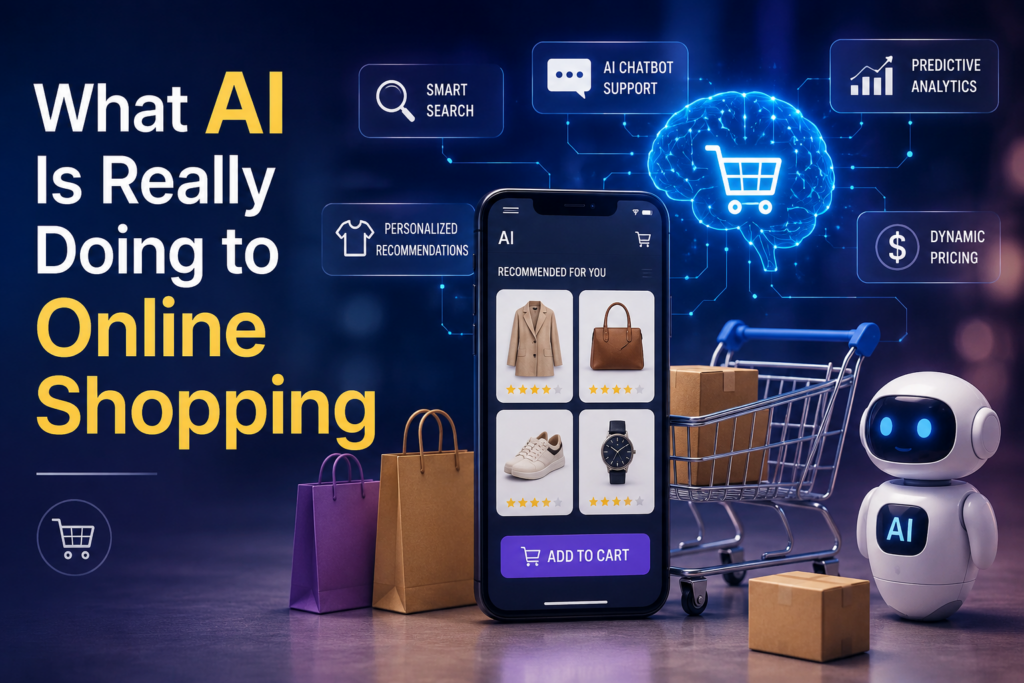
Ten years ago, “good” e-commerce meant a working search bar and a checkout that didn’t crash. Now shoppers expect the site to basically know what they want before they do, answer questions at 2am, and get the package there in two days. That’s a lot to ask of a human team, which is part of why AI has become less of a nice-to-have and more of a baseline requirement.
It’s worth being specific about what “AI in e-commerce” actually means, because the term gets used loosely. In practice it’s machine learning models, natural language processing, and automation pulling from customer data to do things a person would otherwise have to do by hand — except faster, and at a scale no support team could match.
A few places this shows up in real stores:
- Product recommendations that go beyond “people who bought X also bought X”
- Chat support that can actually resolve a return or a tracking issue, not just hand off to a human
- Marketing that triggers off behavior instead of a calendar
- Pricing that adjusts based on demand and competitor moves
- Search that works from a photo, not just a typed query
- Behind-the-scenes work like fraud detection and inventory forecasting
Why this matters more than it used to
Customer experience is arguably the deciding factor in online retail now — more than price, in a lot of cases. People don’t have patience for a slow site or a search filter that doesn’t work. They just leave. AI’s real value isn’t novelty; it’s removing the small frictions that used to cost a sale.
Recommendations that actually track intent
The old model of recommendations was pretty dumb: buy a coffee maker, get shown more coffee makers. AI-driven systems instead look at browsing patterns, timing between purchases, and stated preferences to build something closer to an actual profile. Someone buying fitness gear might get shown running shoes or a fitness tracker — not a second yoga mat. That relevance is what tends to push up average order value.
Search and visual discovery
A huge number of site abandonments happen because someone couldn’t find the thing they were looking for. Better search — the kind that understands “comfortable running shoes for flat feet” instead of choking on it — closes that gap. Visual search takes it further: snap a photo of a jacket you saw online, and the system can find visually similar products in the catalog.
Predicting what happens next
This is where a lot of the operational value sits. If a system notices a customer reliably reorders skincare every two months, it can prompt a reminder right before that window. Multiply that across a customer base and you get meaningfully better inventory planning. The same kind of pattern-recognition is used for fraud detection — catching odd purchasing behavior or signs of a stolen card in real time, rather than after the fact.
On the consumer side, surveys from Gartner have suggested that shoppers are generally open to AI assistance while shopping — though accuracy is the thing that makes or breaks whether people actually trust it.
The part nobody puts in the headline: it’s hard to implement
None of this is plug-and-play. Real obstacles include privacy regulations like GDPR, messy or incomplete data, and the simple fact that most retailers are trying to bolt new AI tools onto an old CRM or inventory system that wasn’t built for it. An AI support agent can cut down a ticket backlog significantly, but only if it’s working from clean, well-structured data — otherwise it just gets things wrong faster.
If you’re trying to build this kind of system properly — solid architecture, predictive analytics that actually integrate with what you already run — that’s the kind of project our team at Webiwork Technologies works on.
Frequently Asked Questions
Does AI personalization actually move conversion rates, or is that overstated? It’s not magic, but the mechanism is real: instead of showing every visitor the same homepage, the store adapts based on what that specific person has done and is likely to want. Less friction between browsing and buying tends to show up directly in conversion and order value.
Is this only realistic for big retailers with engineering teams?
No — that used to be true, but there’s now a wide range of SaaS tools and APIs that let smaller stores plug in machine learning features without building anything from scratch. The harder part is usually picking the right tool and integrating it cleanly, which is where a development partner tends to help.
How is an “AI shopping agent” different from a regular chatbot?
Old-style chatbots are scripted — if the customer’s question doesn’t match a pre-written path, the bot just fails. Tools built on modern language models can actually parse what someone means, deal with typos and odd phrasing, and walk a customer through something like a return policy without needing it spelled out in advance.
What are the biggest security advantages of using AI in e-commerce?
Legacy security systems rely on rigid, pre-set rules to flag fraud, which often blocks legitimate customers by mistake. AI fraud detection monitors thousands of data points—like behavioral biometrics, device fingerprints, and purchase velocity—in real time. This allows the system to instantly stop account takeovers and stolen card usage while ensuring real customers experience a smooth checkout.