
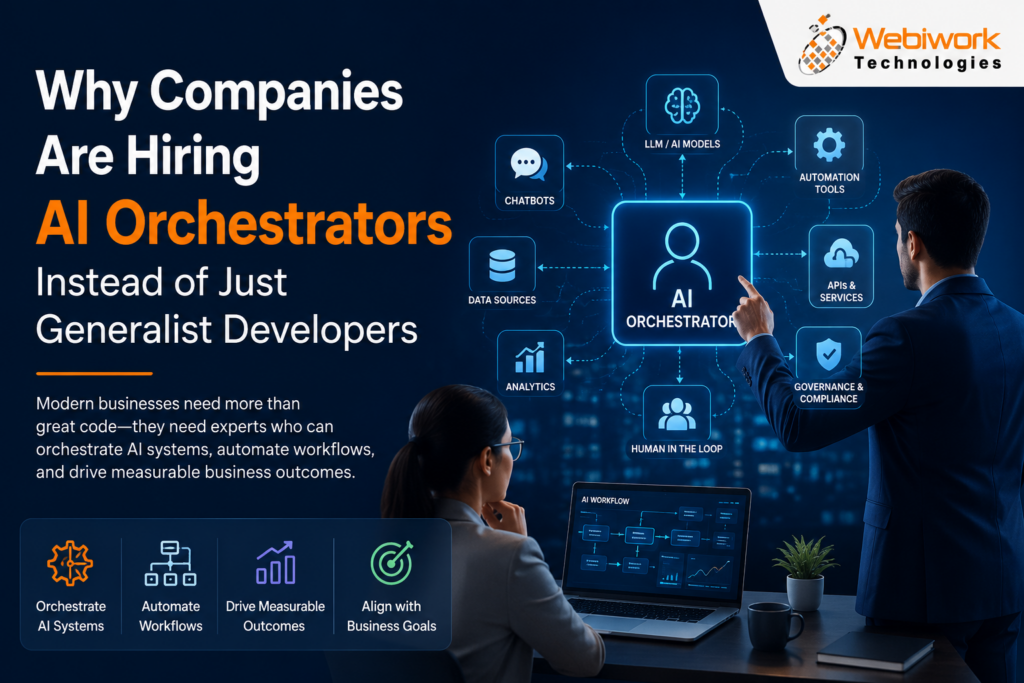
Software development is undergoing one of the most significant shifts in its history. For years, businesses depended on generalist developers — engineers capable of handling frontend interfaces, backend logic, databases, and deployment pipelines all at once. That skill set still has real value. But the growth of artificial intelligence has changed the way companies design, scale, and automate their digital operations.
Leadership teams are no longer asking how many developers they need to hire. Instead, they are asking how to coordinate several AI systems at once to produce measurable business results.
Out of this shift, a new role has emerged: the AI orchestrator.
As businesses increasingly rely on AI-powered workflows, automation tools, intelligent agents, and machine learning technologies, the role of the AI orchestrator is becoming more important. These professionals help bridge the gap between technology and business goals by ensuring that AI systems are used effectively, aligned with organizational needs, and capable of delivering practical results. Their work combines technical understanding, strategic planning and operational oversight to turn AI capabilities into real business value.
This article looks at why businesses are increasingly bringing on AI orchestrators rather than relying solely on generalist developers, what the role actually involves, and what it signals about the direction of software development.
How Software Development Roles Have Evolved
Conventional software development followed a fairly linear process: gather requirements, write the code, test it, deploy it, and maintain it over time. Generalist developers thrived in this model because most applications relied on a fixed technology stack with predictable behavior.
Modern AI-driven systems don’t work that way. Businesses today are combining large language models, autonomous AI agents, workflow automation platforms, predictive analytics tools, machine learning models, API-based AI services, and decision-making systems that operate with far less predictability than traditional software.
These tools have to function together, not in isolation. Writing good code is simply no longer sufficient on its own. Companies increasingly need people who understand model selection, prompt design, workflow architecture, automation strategy, data pipelines, governance, and how to build effective human-in-the-loop checkpoints.
That combination of skills is exactly what defines an AI orchestrator.
What Does an AI Orchestrator Actually Do?
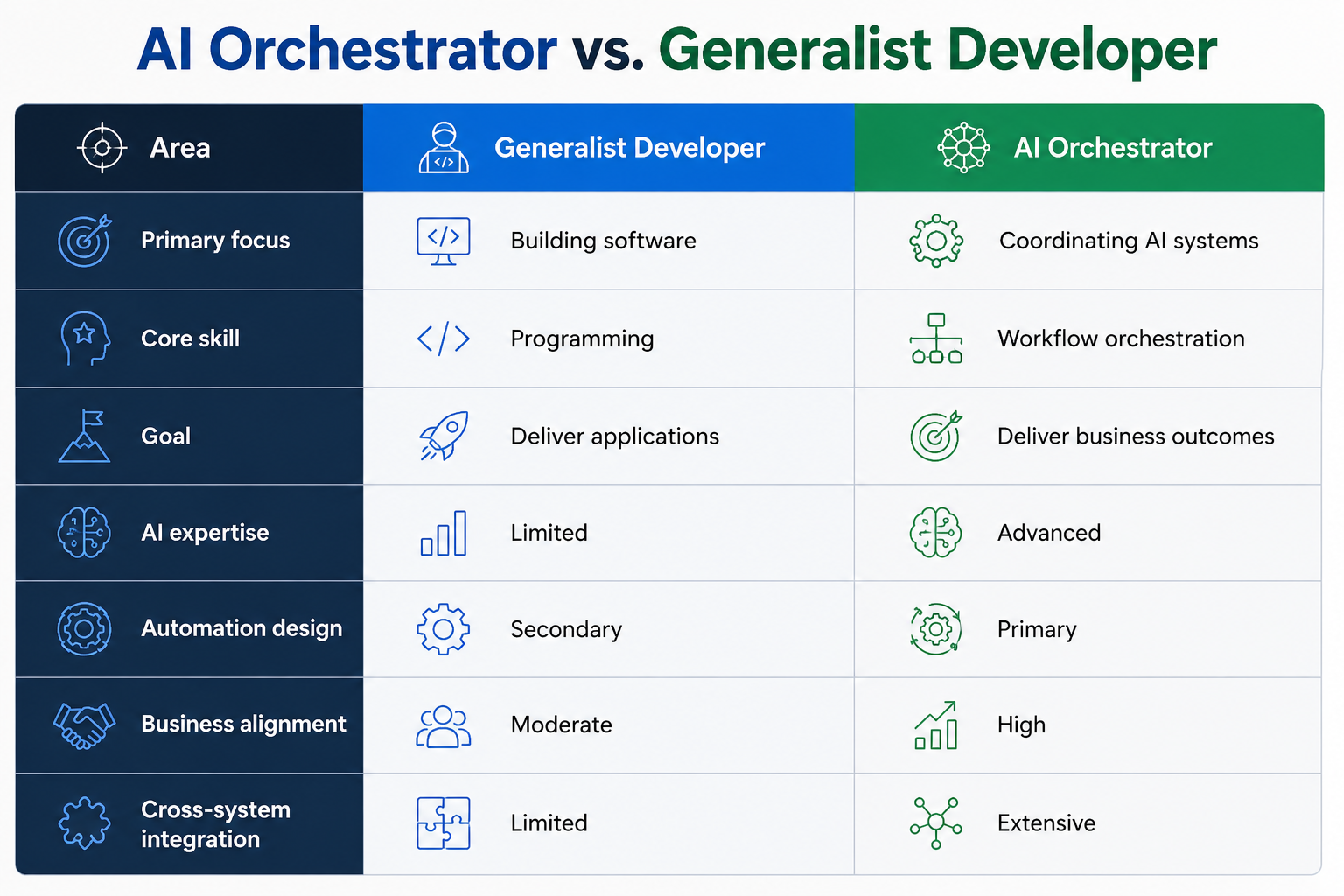
An AI orchestrator manages the interaction between multiple AI tools, automated workflows, and human team members in order to achieve a defined business goal. Rather than spending most of their time writing code, they spend it designing how intelligent systems work together.
Designing AI workflows – Orchestrators build end-to-end processes where several AI tools pass information back and forth. A single customer inquiry, for instance, might move through an AI chatbot, a sentiment-analysis model, a CRM platform, a sales-automation tool, and eventually a human sales representative — and the orchestrator is responsible for making sure that handoff happens smoothly.
Integrating AI tools – Most companies aren’t relying on just one AI vendor. They’re combining platforms like OpenAI, Anthropic’s Claude, Google Gemini, Microsoft Copilot, Salesforce Einstein and HubSpot AI. Someone has to connect these systems into a workflow that actually functions as a whole and that’s the orchestrator’s job.
Automating business processes – Orchestrators look for repetitive, time-consuming tasks — customer support, lead qualification, content production, data analysis, reporting, document handling — and figure out how to automate them using the right combination of AI tools.
Maintaining AI governance – As AI becomes embedded in daily operations, someone needs to watch over compliance, data security, model performance, and the ethical use of these systems. That oversight responsibility increasingly falls to the orchestrator as well.
Why Generalist Developers Alone Aren’t Enough Anymore
AI systems behave differently than traditional software
Conventional applications run on fixed rules, so a developer can usually predict how a piece of software will behave. AI systems are probabilistic by nature, which means predicting their output requires a different skill set entirely — prompt optimization, context management, and ongoing performance monitoring — that falls outside the scope of traditional programming work.
The real business value now comes from how systems are connected
Writing software in isolation no longer creates much of a competitive edge on its own. The advantage now comes from connecting systems intelligently. A marketing team, for example, might be using CRM software, AI content tools, analytics dashboards, and social media automation simultaneously. The hard part isn’t writing code for any single tool — it’s making all of them work together in a coherent workflow. That’s precisely the kind of problem AI orchestrators are built to solve.
AI adoption requires thinking across the whole business, not just IT
Rolling out AI successfully takes cooperation between IT, marketing, operations, customer service, finance, and legal. Generalist developers tend to be focused on technical execution within their own domain. AI orchestrators are trained to think about how AI capability maps onto broader business goals, which makes them better suited to lead cross-functional AI initiatives.
Low-code and no-code platforms are changing what “development” means
Tools such as Zapier, Make, Microsoft Power Automate, and n8n now let businesses build sophisticated automated workflows with little or no custom code. As these platforms keep adding native AI features — and as all of them have moved aggressively into AI agent support through 2025 and 2026 — the bottleneck shifts away from writing every line of code by hand and toward architecting the workflow itself. That shift plays directly into the strengths of an orchestrator rather than a traditional developer.
Core Skills an AI Orchestrator Needs
AI strategy – The ability to identify where AI can realistically add value, evaluate the return on a given use case, and build out a sensible roadmap for adoption.
Prompt engineering – Crafting instructions that get consistent, high-quality output from AI models — covering context design, response tuning, and prompts built for multi-step workflows rather than one-off queries.
Systems integration – Practical knowledge of how to connect APIs, databases, SaaS platforms, and AI models so they exchange data reliably.
Data management – AI systems are only as good as the data feeding them, so orchestrators need to manage data flow, data quality, security, and the knowledge bases that AI tools draw from.
Automation design – The ability to build automated processes that can scale without requiring proportional increases in manual oversight.
Which Industries Are Driving the Demand
Healthcare organizations are using orchestration to connect patient records, diagnostic tools, scheduling systems, and AI-powered clinical assistants.
Ecommerce and retail companies rely on orchestration for product recommendations, customer support automation, inventory forecasting and marketing automation.
Financial services firms apply it to fraud detection, risk analysis, regulatory compliance monitoring, and automated reporting.
Manufacturing companies coordinate predictive maintenance, quality control, supply chain intelligence, and production planning through orchestrated AI systems.
Professional services and consulting firms use orchestration to automate research, generate proposals, manage institutional knowledge, and streamline client communication.
The Business Impact of AI Orchestration
Done well, AI orchestration speeds up decision-making by getting the right insights to the right people faster. It tends to reduce operational costs by cutting down on manual data entry, repetitive administrative work, and support overhead. It improves the customer experience through faster response times, more personalized recommendations, and more consistent communication. And it allows a business to scale its operations without needing to scale headcount at the same rate.
The Growth of Multi-Agent AI Systems
A major driver behind the demand for AI orchestrators is the move toward multi-agent environments, where companies deploy several specialized AI agents at once — research agents, customer support agents, sales agents, coding agents, and analytics agents — instead of relying on a single model to handle everything.
When these agents aren’t coordinated properly, the result is fragmentation rather than efficiency. AI orchestrators are responsible for managing how agents communicate with each other, sequencing the steps in a workflow, delegating tasks appropriately, maintaining quality control, and building in human approval checkpoints where they’re needed. As multi-agent setups become more common, this coordination role becomes increasingly indispensable.
What to Look for When Hiring an AI Orchestrator
Strong candidates typically bring a mix of:
- Technical understanding — familiarity with Python, APIs, cloud platforms, and databases
- AI experience — hands-on knowledge of large language models, AI agents, machine learning fundamentals and prompt engineering
- Business knowledge — a solid grasp of operations, customer journeys, process optimization and revenue drivers
- Communication skills — the ability to translate between executives, developers, stakeholders and end users
Where AI Orchestration Is Headed
Industry signals point toward AI orchestration becoming one of the most important functions inside organizations over the next several years. As AI tools become more accessible and more capable on their own, the real challenge shifts from building the technology to coordinating it effectively across the business.
It’s reasonable to expect more companies will build dedicated teams around AI orchestration, agent management, automation governance, and AI strategy execution. Businesses that build this capability early are likely to gain a meaningful efficiency and innovation advantage over slower-moving competitors.
Conclusion
The days of leaning entirely on generalist developers are giving way to something more layered. Software engineering still matters — it isn’t going anywhere — but modern businesses also need people who can connect AI systems, automate workflows end-to-end, and tie all of it back to strategic goals.
AI orchestrators represent the next phase of this transition. Their focus isn’t just on writing code; it’s on building intelligent ecosystems that produce measurable results for the business. Companies that invest in AI orchestration now are setting themselves up to operate faster and more efficiently as AI becomes even more deeply woven into how business gets done.
The real question for most organizations today isn’t whether they need AI expertise. It’s whether they have the right people in place to orchestrate it.
At WebiWork Technologies, we help businesses turn AI from a promising concept into a practical competitive advantage. From AI-powered automation and custom software development to intelligent workflow orchestration and scalable digital solutions, our experts build systems that deliver measurable business results. Ready to future-proof your business? Contact WebiWork Technologies today and discover how our AI and software solutions can accelerate your digital transformation.
Frequently Asked Questions
What is an AI orchestrator?
An AI orchestrator is a professional who designs, manages and coordinates AI systems, automation tools, workflows and human interactions in order to achieve specific business objectives efficiently.
How is an AI orchestrator different from a software developer?
Software developers are primarily focused on building applications and writing code. AI orchestrators focus on connecting multiple AI tools, automated workflows and business processes into a cohesive, end-to-end system.
Do AI orchestrators need coding skills?
Generally, yes, though not always at the depth a full-time developer would need. A working knowledge of Python, APIs, cloud platforms, and automation frameworks is highly useful for the role, even if extensive coding isn’t always required day to day.
Why are businesses hiring AI orchestrators?
Companies need people who can integrate various AI technologies, automate repetitive processes, improve operational efficiency, and keep AI initiatives aligned with actual business goals — something that falls outside the traditional scope of a development role.
Can small businesses benefit from AI orchestration?
Yes. Even without a large technical team, AI orchestration can help small businesses automate customer support, lead generation, marketing tasks and reporting without a significant increase in staffing costs.
What tools do AI orchestrators commonly use?
Common tools include OpenAI’s models, Anthropic’s Claude, Google Gemini, Microsoft Copilot and automation platforms such as Zapier, Make, Power Automate, and frameworks like LangChain.
Is AI orchestration replacing software development?
No. The two functions complement each other. Developers build the underlying systems, while orchestrators coordinate the AI technologies and workflows running on top of them to maximize business value.